
MBBS vs BDS in China 2026 | Which Medical Career Path Is Right For You?
June 20, 2026 | by baharedu.com
MBBS vs BDS in China 2026 | Which Medical Career Path Is Right For You?
1. Introduction to Medical Education in China
The decision to pursue a career in the healthcare sector is one of the most noble, rewarding, and challenging choices a student can make. As the global population expands and medical technology advances, the demand for highly skilled medical professionals—both doctors and dentists—has reached unprecedented levels. For international students, specifically from Pakistan, India, Africa, and the Middle East, finding the right platform to launch this career is crucial. This brings us to the ultimate debate for pre-medical students: MBBS vs BDS in China 2026.
Over the last decade, China has rapidly evolved into an educational superpower, becoming the leading destination for international medical students. The growing popularity of China among international students is driven by state-of-the-art infrastructure, highly subsidized tuition fees, World Health Organization (WHO) recognition, and the availability of 100% English-taught programs.
However, once you have decided on China as your study destination, the most critical question arises: Should you opt for Clinical Medicine (MBBS) or Dental Surgery (BDS)? Choosing the right medical program is the foundation of your entire professional life. It dictates your daily routine, your patient interactions, your financial stability, and your work-life balance for decades to come. Because both paths offer immense respect and financial rewards, “MBBS vs BDS” is one of the most searched questions by pre-medical students globally. This comprehensive guide, brought to you by BAHAR EDUCATIONAL CONSULTANTS Ltd. Pvt, will provide an in-depth analysis to help you make an informed decision for the 2026 intake.
2. Understanding MBBS in China
What is MBBS?
MBBS stands for Bachelor of Medicine, Bachelor of Surgery. In the Chinese educational framework, this degree is formally awarded as the Bachelor of Clinical Medicine. It is the primary undergraduate degree required to become an allopathic medical doctor. The MBBS degree equips students with comprehensive knowledge of the entire human body, diagnosing diseases, prescribing medications, and performing life-saving surgical procedures.
Program Structure
When you choose to study MBBS in China, you commit to a rigorous 6-year academic journey. The structure is meticulously designed to transform a high school graduate into a competent medical practitioner.
- Theory Classes (Pre-Clinical): The initial years focus heavily on foundational medical sciences. Students dive deep into Anatomy, Physiology, Biochemistry, Pharmacology, Pathology, and Microbiology. This phase builds the core understanding of how the human body functions and fails.
- Practical Training: Alongside theoretical lectures, students spend countless hours in advanced laboratories, utilizing digital anatomy tables, microscopes, and simulation mannequins to bridge the gap between textbook knowledge and reality.
- Clinical Rotations: In the 4th and 5th years, the focus shifts to clinical subjects like Internal Medicine, General Surgery, Pediatrics, Gynecology, and Neurology. Students begin observing real patient cases in university-affiliated hospitals.
- Internship: The final 6th year is entirely dedicated to a mandatory clinical internship. Students rotate through various hospital departments, actively assisting senior doctors, interacting with patients, and honing their diagnostic and clinical skills.
Medical Licensing Pathways & Global Recognition
A massive advantage of pursuing an MBBS in China is its global recognition. Graduates from universities listed in the World Directory of Medical Schools (WDOMS) are eligible to take international licensing exams. For Pakistani students, this means appearing for the PMDC (Pakistan Medical & Dental Council) NLE exam. Graduates are equally eligible for USMLE (USA), PLAB (UK), AMC (Australia), and other global certifications.
3. Understanding BDS in China
What is BDS?
BDS stands for Bachelor of Dental Surgery. It is the designated undergraduate degree for students aspiring to become professional dentists, dental surgeons, or oral health specialists. While MBBS covers the entire body, BDS provides an intense, hyper-focused study of the oral cavity, maxillofacial region, teeth, gums, and related structures.
Program Structure
The BDS program in China is typically structured as a 5-year degree, making it a faster route to professional practice compared to MBBS.
- Dental Training (Pre-Clinical): The first two years share similarities with MBBS, covering General Anatomy and Physiology. However, the curriculum quickly narrows to Dental Anatomy, Oral Histology, and Dental Materials.
- Practical Skills: Dentistry is an incredibly hands-on profession. Students spend extensive time in “Phantom Head” laboratories, practicing drilling, filling, and extraction techniques on dummy models before they ever touch a human patient.
- Clinical Practice: The 3rd and 4th years focus on core dental subjects such as Prosthodontics, Orthodontics, Periodontics, Oral Pathology, and Maxillofacial Surgery.
- Internship: The final 5th year is a dedicated clinical internship in a dental hospital or clinic. Under strict supervision, interns perform actual dental procedures, manage patient pain, and learn the operations of a dental practice.
Career Pathways & International Recognition
BDS graduates from recognized Chinese dental universities enjoy vast international recognition. They are eligible to practice in their home countries after clearing the respective national dental board exams (such as the PMDC for Pakistan). The degree paves the way for lucrative private practices, cosmetic dentistry, and specialized postgraduate studies.
4. MBBS vs BDS – Complete Comparison Table
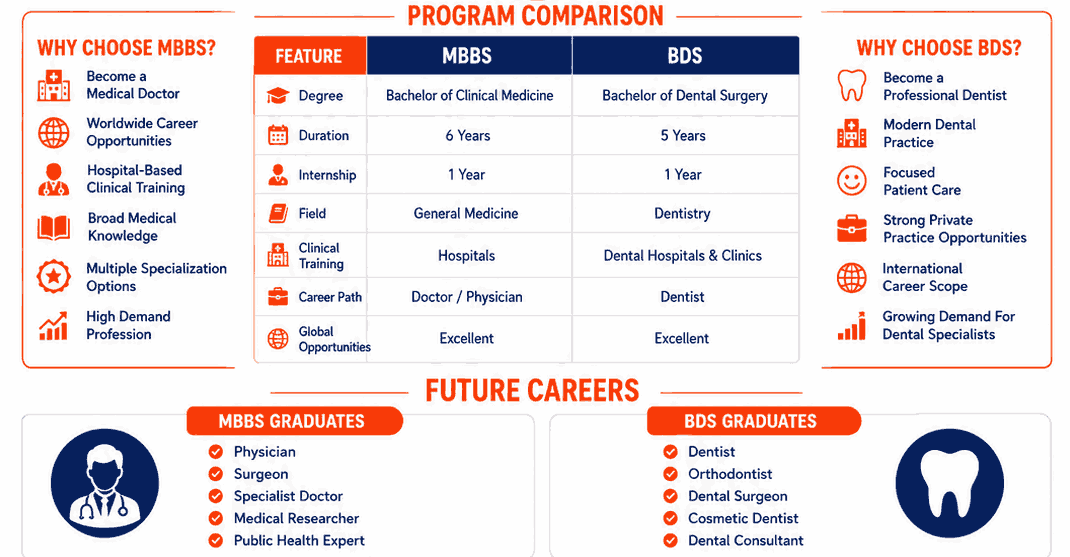
To help you visualize the differences and similarities, we have compiled a comprehensive comparison table between MBBS and BDS programs in China for the 2026 intake.
| Comparison Criteria | MBBS (Clinical Medicine) | BDS (Dental Surgery) |
|---|---|---|
| Degree Awarded | Bachelor of Clinical Medicine / MBBS | Bachelor of Dental Surgery / BDS |
| Program Duration | 6 Years (5 Years Study + 1 Year Internship) | 5 Years (4 Years Study + 1 Year Internship) |
| Core Focus | Entire human body, systemic diseases, general health. | Oral cavity, teeth, gums, maxillofacial region. |
| Clinical Training | Hospital-based, intensive rotations in various wards. | Dental clinic-based, high focus on manual dexterity. |
| Career Path | Physician, Surgeon, Medical Specialist. | Dentist, Dental Surgeon, Orthodontist. |
| Work Environment | Hospitals, Emergency Rooms, Clinics. | Private Dental Clinics, Dental Hospitals. |
| Patient Care Scope | Life-saving treatments, chronic disease management. | Oral hygiene, cosmetic enhancements, pain relief. |
| Specializations | Cardiology, Neurology, Pediatrics, Oncology, etc. | Orthodontics, Endodontics, Oral Surgery, Pedodontics. |
| Global Recognition | WHO, PMDC, GMC, ECFMG, AMC. | WHO, PMDC, DCI, and international dental boards. |
| Average Study Cost (Per Year) | $3,000 to $6,000 (Tuition) | $2,500 to $5,500 (Tuition) |
| Job Demand | Extremely High (Global Shortage) | High (Especially in Cosmetic Dentistry) |
| Work-Life Balance | Challenging (On-call duties, emergency shifts). | Excellent (Predictable clinic hours, rarely emergencies). |
| Private Practice Potential | Requires years of experience and specialization. | Immediate setup possible right after licensing. |
5. Detailed Breakdown of the MBBS Program in China
Choosing to Study MBBS in China is a commitment to excellence. The program is systematically structured to create world-class doctors. For the 2026 intake, universities have further modernized their curriculum to integrate Artificial Intelligence in medicine and advanced robotic surgery concepts.
- Duration: Exactly 6 Years.
- Internship: 1 Year mandatory clinical internship in the final year.
- Hospital Based Training: Unlike some degrees, MBBS is highly hospital-centric. By the 4th year, your classroom effectively shifts to the hospital wards. You will observe surgeries, manage inpatient files, and attend morning rounds with senior consultants.
- Clinical Exposure: China’s massive population ensures that medical students witness a vast array of clinical cases, rare diseases, and massive patient turnovers, providing unparalleled clinical exposure.
- Medical Specializations: An MBBS is a stepping stone. Post-graduation, you can specialize in over 50 different fields, from Neurosurgery and Dermatology to Psychiatry and Internal Medicine.
- Global Opportunities: The degree serves as a global passport. With proper licensing, Chinese MBBS graduates are successfully practicing in the USA, UK, Middle East, and Pakistan.
6. Detailed Breakdown of the BDS Program in China
The decision to Study BDS in China is brilliant for students who blend scientific aptitude with artistic precision. Dentistry is as much an art as it is a medical science. The aesthetic reconstruction of a smile requires incredible attention to detail.
- Duration: A concise 5 Years.
- Internship: 1 Year mandatory internship in affiliated stomatology (dental) hospitals.
- Dental Clinics & Patient Care: Training occurs in highly sterile, modern dental setups. Students learn to handle sophisticated dental chairs, precise rotary instruments, and advanced dental imaging technologies (like CBCT).
- Dental Procedures: From basic scaling and polishing to complex root canal treatments, tooth extractions, and crown placements, the curriculum ensures you are physically capable of performing procedures before you graduate.
- Private Practice Opportunities: The greatest allure of BDS is the autonomy it provides. Dentists are often entrepreneurs. Setting up a private dental clinic requires less infrastructural investment compared to a full-scale medical hospital.
- Global Career Growth: Cosmetic dentistry is booming worldwide. The demand for smile design, veneers, and clear aligners offers massive global career growth and high financial returns.
7. Why Choose MBBS? The Path of the Healer
If you are still debating “MBBS or BDS Which Is Better”, here are compelling reasons to expand professionally with an MBBS degree:
- Become a Medical Doctor: You earn the ultimate title of ‘Doctor’ in the truest sense, equipped to handle life-and-death situations.
- Worldwide Career Opportunities: The human body is the same everywhere. A doctor from China can save a life in Africa, Europe, or America. The skills are universally desperately needed.
- Hospital-Based Clinical Training: If you thrive in high-energy, fast-paced environments like Emergency Rooms or operation theaters, MBBS provides that adrenaline.
- Broad Medical Knowledge: You will understand the intricate connections between all body systems, making you a holistic healthcare provider.
- Multiple Specialization Options: The ceiling for growth is limitless. You can become a heart surgeon, a brain specialist, or a pediatrician.
- High Demand Profession: Post-pandemic, the world has realized the severe shortage of general physicians and specialists. Job security is absolute.
- Public Health Careers: MBBS graduates can transition into global health organizations like the WHO or national health ministries to shape health policies.
8. Why Choose BDS? The Art of Precision
BDS is not merely an alternative to MBBS; it is a premier medical science in its own right. Here is why you should choose to become a dental surgeon:
- Become a Professional Dentist: You become an undisputed expert in oral health, a crucial component of overall systemic health.
- Modern Dental Practice: Dentistry is highly technology-driven. You will work with lasers, 3D intraoral scanners, and CAD/CAM milling machines.
- Focused Patient Care: Dental procedures often yield immediate results. Relieving a patient’s excruciating toothache in a single visit brings immense immediate job satisfaction.
- Strong Private Practice Opportunities: Dentists are highly successful entrepreneurs. You can be your own boss right from the start of your career.
- Growing Demand For Dental Specialists: As living standards rise globally, people are investing heavily in aesthetic and cosmetic dentistry.
- Better Work-Life Balance: This is the biggest winning point for BDS. Dental emergencies outside clinic hours are rare. You can enjoy weekends, holidays, and regular family time without the stress of midnight hospital calls.
9. Career Opportunities After MBBS
Graduating with an MBBS from a Chinese Medical University opens doors to a vast array of career paths. Your journey doesn’t end with the degree; it merely begins.
- General Physician: The first point of contact for patients, running private clinics or primary healthcare centers.
- Surgeon: After postgraduate training, performing complex operative procedures.
- Specialist Doctor: Focusing on specific organs (e.g., Cardiologist, Dermatologist, Endocrinologist).
- Medical Researcher: Working in labs to discover new drugs, vaccines, or treatment protocols.
- Public Health Expert: Managing community health, epidemiology, and disease control programs.
- Healthcare Administrator: Running hospital operations, combining medical knowledge with management skills (often requiring an MBA or MHA).
- International Medical Practice: Serving in NGOs like Doctors Without Borders or practicing in first-world countries.
10. Career Opportunities After BDS
A BDS degree provides a highly specialized and lucrative set of career options. The scope of dentistry has expanded far beyond simple extractions.
- General Dentist: Providing routine dental care, fillings, and preventive oral health advice.
- Orthodontist: Specializing in aligning teeth and jaws using braces and clear aligners.
- Maxillofacial Surgeon: Performing complex surgeries on the face, jaw, and neck, often bridging the gap between dentistry and medicine.
- Cosmetic Dentist: Focusing on smile makeovers, veneers, and teeth whitening.
- Dental Clinic Owner: Managing a chain of successful private dental practices.
- Dental Educator: Teaching future generations of dentists in academic institutions.
- Dental Material Researcher: Innovating new biocompatible materials for implants and prosthetics.
11. MBBS vs BDS: Detailed Salary Comparison
Financial stability is a major factor when deciding between medical career options. Both MBBS and BDS offer highly lucrative futures, but the trajectory of earning differs. Dentists often start earning higher amounts earlier due to private practice, while MBBS doctors see massive salary spikes after completing their long specializations.
| Region / Country | Average MBBS Graduate Salary (Entry-Mid Level) | Average BDS Graduate Salary (Entry-Mid Level) |
|---|---|---|
| Pakistan | PKR 100,000 – 250,000 / month (Govt/Private Hospital) | PKR 80,000 – 300,000+ / month (High variance due to private clinic earnings) |
| China (If Practicing) | RMB 15,000 – 30,000 / month | RMB 12,000 – 35,000 / month (Cosmetic clinics pay premium) |
| Middle East (UAE, Saudi Arabia) | AED 15,000 – 35,000 / month | AED 12,000 – 40,000 / month (Huge demand for aesthetic dentistry) |
| Europe (UK – NHS) | £35,000 – £60,000 / year (Junior Doctor level) | £38,000 – £70,000 / year (NHS + Private mixes) |
| International Markets (USA/Aus) | $60,000 – $150,000 / year (Residency/Early Attending) | $120,000 – $200,000+ / year (Associate Dentist) |
Note: Salaries are approximate estimates based on current market trends and require clearing local licensing exams.
12. Who Should Choose MBBS?
Counseling students is at the core of what we do at BAHAR EDUCATIONAL CONSULTANTS. MBBS is not for the faint-hearted. You should choose MBBS if you possess the following traits:
- High Emotional Resilience: You will deal with severe illness, trauma, and sometimes the loss of life. You need the mental strength to handle immense pressure.
- Insatiable Curiosity: The human body is infinitely complex. If you have a burning desire to understand systemic diseases, internal organs, and complex pharmacology, medicine is your calling.
- Stamina for Long Hours: MBBS requires years of grueling study, followed by 24-36 hour on-call shifts during residency. Physical and mental stamina is non-negotiable.
- Desire for Broad Impact: If your career goal is to perform life-saving surgeries or manage critical ICU patients, only an MBBS degree can take you there.
13. Who Should Choose BDS?
BDS requires a very specific, unique skill set. It is the perfect blend of science, engineering, and art. You should choose BDS if you have:
- Exceptional Hand-Eye Coordination: You will be working in a space no larger than a few inches (the mouth), using high-speed drills millimeters away from vital nerves. Steady hands are essential.
- An Eye for Aesthetics: If you appreciate symmetry, color matching, and design, cosmetic dentistry allows you to utilize these artistic skills to recreate beautiful smiles.
- Entrepreneurial Spirit: If you dream of owning your own business, designing your clinic, and managing your own schedule, BDS paves a much faster route to private practice.
- Desire for Work-Life Balance: If you want a respected, high-income medical career but also value your evenings, weekends, and personal life, dentistry is the far superior choice.
14. Student Life in China: What to Expect in 2026
Studying abroad is about more than just academics; it is about holistic personal growth. China offers an incredibly vibrant, safe, and enriching environment for international medical students.
- Accommodation: Universities provide dedicated international student dormitories that are secure, fully furnished, and equipped with heating, air conditioning, and internet access.
- Food & Halal Options: A major concern for Pakistani students is food. Rest assured, almost every Chinese university campus features dedicated Muslim canteens serving hygienic, affordable, and delicious Halal food.
- Unmatched Safety: China is statistically one of the safest countries globally. With extensive campus security and strict public safety laws, parents can have complete peace of mind.
- Transportation: China boasts the world’s most advanced public transport system. Bullet trains and expansive subway networks make traveling across the country cheap and incredibly fast.
- International Community: You will share your classroom with students from Asia, Africa, Europe, and the Americas, building a global network of future medical professionals.
- Cultural Experience: Learning the Chinese language (Mandarin) and experiencing a 5000-year-old culture adds immense value to your personal development and global employability.
15. MBBS vs BDS – Which Has a Better Future?
When analyzing the long-term prospects, neither degree is objectively “better” than the other; rather, they offer different avenues of success.
The Future of MBBS: The future is incredibly secure. Aging global populations and the rise of chronic diseases guarantee that doctors will remain in high demand. Advancements in telemedicine and robotic surgery will change how doctors work, but will never replace the need for them. The income potential grows exponentially with age and specialization.
The Future of BDS: Dentistry is undergoing a technological renaissance. The shift towards preventative and cosmetic dentistry means people are visiting dentists by choice, not just in pain. The integration of 3D printing for immediate crowns and AI for orthodontic planning makes the future of BDS highly lucrative, tech-driven, and less physically taxing than before.
16. Final Recommendation by Educational Experts
At BAHAR EDUCATIONAL CONSULTANTS, our professional counseling advice is simple: Both MBBS and BDS in China offer excellent, globally recognized career opportunities. Your decision should not be based on societal pressure or minor fee differences.
Choose MBBS if you have a deep passion for understanding the whole body, saving lives in critical conditions, and are prepared for a lifelong journey of intense study and specializations.
Choose BDS if you possess artistic flair, excellent manual dexterity, wish to enter private practice quickly, and prioritize a high-income career with an excellent work-life balance.
Evaluate your own passion, skills, interests, and long-term lifestyle goals. Whichever path you choose, China provides the perfect launchpad for the 2026 intake.
17. Why Apply Through BAHAR EDUCATIONAL CONSULTANTS Ltd. Pvt?
Navigating international admissions can be complex, stressful, and fraught with misinformation. BAHAR EDUCATIONAL CONSULTANTS Ltd. Pvt is Your Trusted Partner For Global Education. Here is why hundreds of students trust us every year:
- Expert University Selection: We match your academic profile and budget with the perfect PMDC and WHO-recognized medical universities.
- Flawless Admission Processing: We handle your entire application, ensuring 100% accurate document submission to secure your JW202 (Admission Letter) swiftly.
- Document Verification & Notarization: We guide you through the complex maze of IBCC, MOFA, and embassy attestations required for Chinese universities.
- Visa Guidance: Our visa success rate for the X1 Student Visa is impeccable. We prepare you for any embassy interviews.
- Scholarship Assistance: Where applicable, we help brilliant students apply for provincial or university-specific performance scholarships.
- Travel & Ticketing Support: We organize group departures, ensuring you travel safely with fellow medical students.
- Post-Arrival Support in China: Our presence isn’t just in Pakistan. With our physical representatives in China, we assist with airport pickup, university registration, dormitory settling, and police registration.
- Continuous Counseling: We remain your mentors throughout your 5 or 6-year journey, providing guidance on licensing exams like PMDC NLE.
Confused About MBBS Or BDS?
Get Free Career Counseling Today!
Admissions for the 2026 intake at top Chinese Medical and Dental Universities are closing fast. Secure your seat with the experts.
🏢 BAHAR EDUCATIONAL CONSULTANTS Ltd. Pvt
👨⚕️ Director: Dr. Sada Bahar
🇵🇰 Pakistan Direct/WhatsApp: +92 322 1100612
🇨🇳 China Office: +86 156 294 50793
✉️ Email: baharedu50@gmail.com
🌐 Website: www.baharedu.com
Apply Now via WhatsApp
19. Frequently Asked Questions (FAQs)
RELATED POSTS
View all

🎓 Hubei Minzu University – MBBS in China 2025 – 2026 with Bahar Educational Consultancy
June 30, 2025 | by baharedu.com
MBBS / BDS in Jiamusi University – September 2026 Intake | Complete Guide
April 19, 2026 | by baharedu.com
MBBS AT NORTH HENAN MEDICAL UNIVERSITY 2026 – Complete Admission Guide for International Students
July 25, 2026 | by baharedu.com